From College Friends to CASSINI Winners:
The Story Behind CodeLeap’s Red Tide Solution
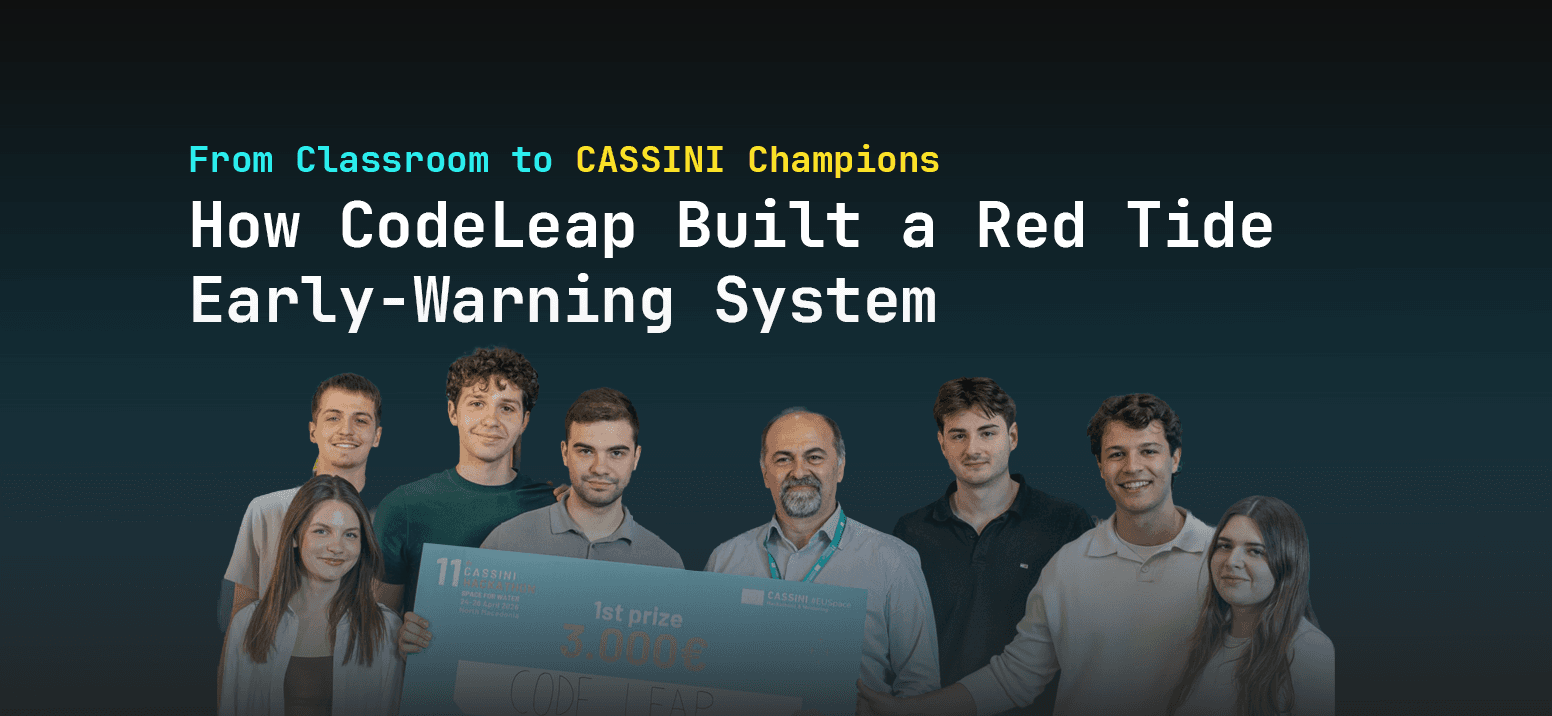
Winning the local CASSINI Hackathon still feels surreal to us. The whole experience was a mix of confidence and euphoria that still hasn’t completely worn off.
Our story as a team started back in our first year of college. Three of us, Jakov, Darko, and Bojan, signed up for the CodeFu hackathon because we were competitive and wanted to try something outside the classroom. We thought, why not? A week later, we ended up winning third place, and after that we got completely hooked on hackathons.
As time passed, our team grew from three people to five when Filip and Nikita joined. For CASSINI, we wanted to build a team with as many different perspectives as possible, so we also invited Simona and Teona to join us. Having people from different fields helped us approach problems from multiple angles and rely on each other’s expertise throughout the competition.
For the hackathon itself, we decided to tackle the challenge of tracking and preventing water pollution. While brainstorming different ideas, our medical expert introduced us to the concept of Red Tide, and immediately we knew we wanted to build something around it. What drew us to the idea was the fact that it was unique and barely anyone else was talking about it.
Our solution combined satellite data with an IoT device to predict algae blooms before they became dangerous. We used publicly available Copernicus satellite data, specifically oxygen and chlorophyll concentrations, and processed them through machine learning models that calculated the probability of algae blooms forming and reaching shorelines. We also designed the system to help hospitals, insurance companies, and local businesses prepare early and minimize damage before the situation escalated.
We felt from the start that other teams probably wouldn’t approach the challenge this way. Most people didn’t even know what Red Tide was, and we were also the only team using an IoT device alongside satellite data.
One of the hardest parts during the 48 hours was managing our time. We were balancing research, development, business planning, and preparing the final presentation all at the same time. At one point during the hackathon, we also discovered that similar solutions already existed in several European countries. For a moment, that stressed us out, but after researching more deeply, we realized our approach was still different enough because of the way we combined technologies and focused on predictive impact analysis.
Everyone on the team had a specific role. Our medical expert helped shape the idea and focused on the human impact behind the project. The business side worked on profitability and the business plan. The engineering team handled the machine learning models and IoT device, while the computer science side focused on the software and connecting all the parts into one working system.
What helped us most as a team was the fact that everyone contributed with their own knowledge and skills. Whenever disagreements came up, we tried to solve them by talking things through and looking at the problem from every possible perspective.
Beyond the technical side, the biggest goal of our project was raising awareness about Red Tide and the danger it poses to marine life, animals, businesses, and people living near affected areas. We believe the product could help hospitals, tourism businesses, farmers, insurance companies, and many other industries react faster and reduce potential losses.
Right now, we still don’t know if we’ll continue building the project, but if the opportunity comes up again, we’d definitely love to continue working on it.
The hackathon taught us much more than just technical skills. We learned teamwork, communication, adaptability, fast decision making, and how to work under pressure. At the same time, we also learned a huge amount about Red Tide itself from biological, technical, and economic perspectives.
One thing that genuinely surprised us was the atmosphere between teams. Everyone was encouraging each other and sharing knowledge. There was a lot of support throughout the event, and every team learned something from the others.
For students thinking about joining hackathons like CASSINI, our advice is simple. As a college student, it’s easy to focus only on academics, but experiences like this help you grow in completely different ways. You learn how to think like an engineer, work with people, solve real problems, and push yourself outside your comfort zone.
That’s one of the best ways to grow as a person.
And if we had to leave one final message, it would be this:
“Innovation doesn’t happen because of a single person. It’s the direct result of people coming together to solve a problem they’re all tired of carrying. When everyone feels the weight of the same struggle, that’s when the real work starts.” — CodeLeap