From Scam SMS to First Place at the First Blockchain Hackathon in Skopje
How five students built SafeChain to help citizens verify Safe City fines
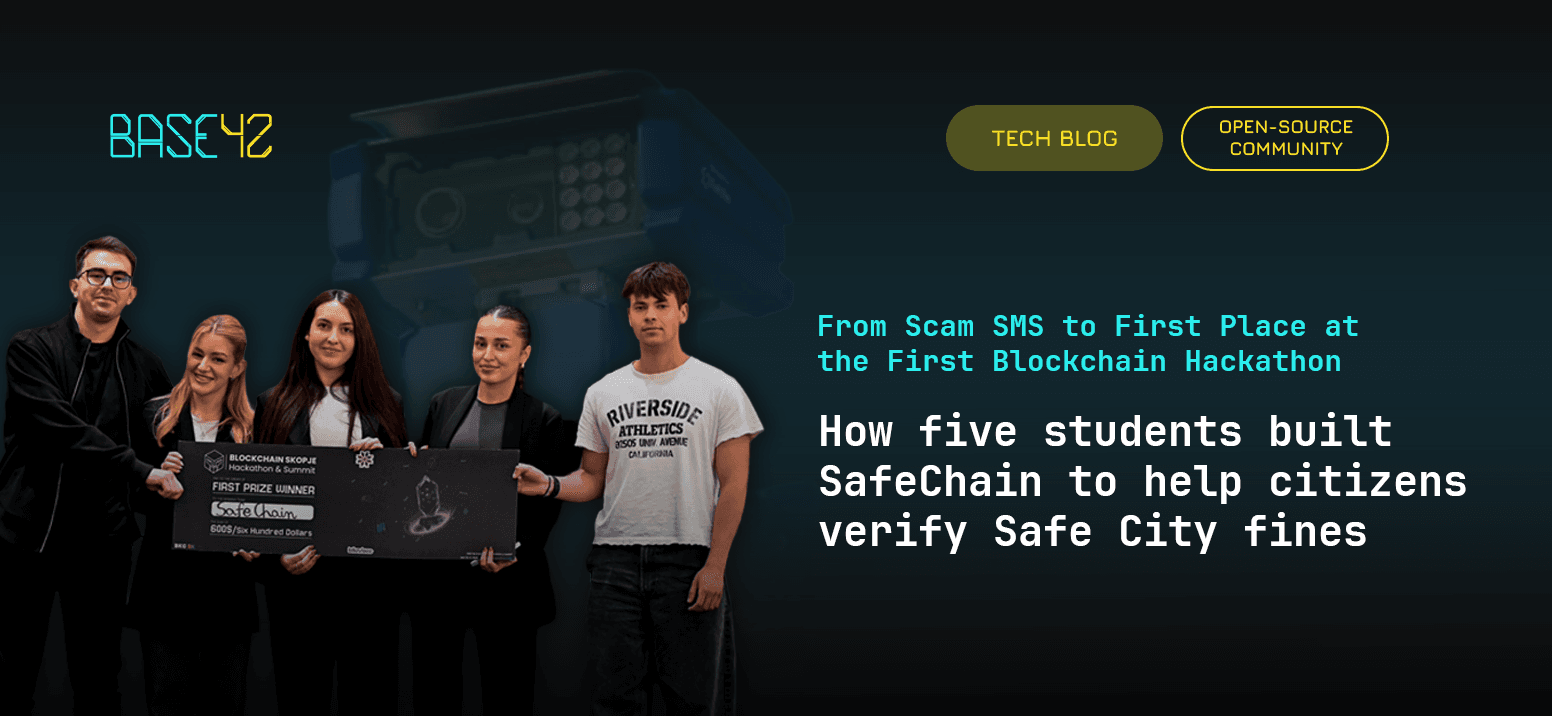
The win meant a lot to us, of course, but the whole experience meant even more because of the idea, the pressure, the teamwork, and the fact that the problem we worked on was something people around us were actually dealing with.
We are Tamara Stojanoska, Sara Andonovska, Hristina Gjorgjievska and Ognen Mladenovski from FINKI, and Dragan Stojchevski from Brainster Next. Four of us are third-year students, while Sara is in her second year, and our team came together through mutual friends while we were preparing for another hackathon.
We met in the same room, started talking over coffee, shared opinions, compared ideas, and very quickly realized that we worked well together and enjoyed the way each person approached problems. After that first hackathon, joining another one together became the next logical step, so when the Blockchain Skopje Hackathon came around, all of us wanted to take part as the same team again.
The Idea
Many good solutions start with a real problem that annoys people enough to make them act, and for us that problem started with an SMS message. During the past month, almost everyone in Macedonia received or heard about a message claiming that they had an unpaid fine from the Safe City system, with a link that looked official and created pressure to pay immediately.
The message looked believable enough to confuse people, and with one wrong click, their money could end up in the hands of someone very difficult to trace. In one afternoon, more than 10,000 fake messages were sent, exposing thousands of citizens to fraud in a single wave, and that made us think that simply telling people to “be careful” still leaves too much room for confusion.
So we started looking at the problem from a different angle and asked why citizens should have to guess whether a message is real in the first place. That question became the starting point for SafeChain, a blockchain-based platform built as a direct response to this exact type of scam.
The main rule behind SafeChain is simple: the official message contains only a verification code, while the citizen opens the official platform themselves, enters the code, and sees all the information there. Each fine is stored as an NFT record with a blockchain transaction hash and a cryptographic signature, which makes the record verifiable, secure, and protected from changes.
The citizen can then see the violation photo, fine details, payment options, and digital appeal process in one place, without being pushed toward a suspicious link in a text message. Removing links from official messages removes the main tool used in these scams, and moving verification to one trusted platform makes the process much clearer for ordinary citizens. At the same time, the platform also reduces bureaucracy because payments, appeals, evidence, and records are all connected in one system and can be accessed quickly.
Building Under Pressure
We came into the hackathon with a clear problem and a strong idea, while blockchain was a new area for us and something we had to learn quickly during the weekend. That pressure was difficult, but it also made the experience valuable because we had to understand the technology well enough to use it for a real case, instead of only talking about it in theory.
The bigger challenge was the product itself, because SafeChain is meant for everyday citizens, including people who receive a suspicious SMS and simply want a clear answer about whether they should trust it. Every decision had to be checked from that point of view, because the platform had to look secure, stay simple, and make sense even to someone hearing the word blockchain for the first time.
During those 48 hours, we moved from five people working on separate parts of the same project into a team that trusted each other’s decisions and understood how to divide the work without making it feel divided. Some of us focused more on programming, others worked on the machine learning aspects, while others developed the business plan and presentation, but in practice we all helped each other whenever something needed attention.
That part made a big difference, because the project improved fastest when we listened, challenged ideas in a constructive way, and gave space to the person who had the clearest solution at that moment.
Technology
The technical foundation of SafeChain was built around one main requirement: the data had to be secure, verifiable, and protected from changes. Each fine is stored on the blockchain as an NFT record, which gives it a permanent and publicly verifiable proof of existence.
On top of that, we built a secure code-verification system, digitally signed PDF appeals, support for card and crypto payments, and a multilingual mobile PWA so citizens can use the platform easily from their phones. All of those features were designed to work as one simple flow, because the technology behind the system matters most when it helps people trust what they are seeing.
The part we are most proud of is the idea of anti-phishing by design, meaning security was built into the process from the beginning and shaped the whole system. SafeChain works because the official communication model itself changes, and when citizens verify information through one trusted platform, scams based on fake payment links lose their power.
Judges & Winning
We came to the hackathon focused on the problem and on making the solution strong enough to explain clearly in front of the judges. During the Q&A with the mentors, the whole idea became even stronger because they asked practical questions, challenged details, and pushed us to think about what SafeChain would need in a real institutional setting.
That conversation helped us understand that the topic was relevant, the timing was right, and the solution was clear enough for people to immediately understand the value behind it. After the presentation, we could see that the project had reached people in the room because everyone understood the problem from personal experience. When the result was announced, the win became recognition of the idea, but also of the way we had worked through the pressure together.
When our team’s name was called first after 48 hours of stress, coding, fixing problems, preparing the pitch, and running on very little sleep, the first reaction was just silence for a second because all five of us were trying to understand that we had actually won. Then everything came out at once, with laughing, hugging, relief, and that strange mix of exhaustion and excitement that comes after you spend a whole weekend building something with people who care about the same goal.
Real-World Impact
SafeChain was built for a very ordinary situation: a person receives a text message, feels unsure if it is real, and wants a safe way to check it without risking their money or personal information. That person could be a student, a parent, a grandparent, or anyone who uses a phone and deals with official payments.
The value is also important for institutions, because many public systems still deal with fragmented records, manual processes, slow communication, and declining public trust. SafeChain gives both citizens and institutions a secure and transparent communication channel where every fine, payment, appeal, and piece of evidence can be verified.
We started with traffic violations because the recent scam made that problem urgent and visible, but the same model can also be used for taxes, healthcare, banking, utilities, and other services where people need to know that a message or record is official. For us, SafeChain is a trust infrastructure, built around a simple idea: citizens should have one clear place to verify official information.
Future Plans
After the hackathon, we finally got some sleep, processed what had happened, and then quickly started thinking about what should come next. SafeChain solves a real problem that people are facing right now, which makes it difficult to treat it only as a hackathon project or a trophy on a shelf.
We are open to partners, collaborators, institutions, and anyone who sees the same potential in the idea. Six months from now, we want SafeChain to be used in practice and supported by the right partners, because the platform is live, tested, and already built to protect people from this kind of fraud.
The project started during a hackathon, but the problem is happening in real life right now, and that is why we want to push SafeChain beyond the competition stage.
Personal Reflection
What surprised us most was how much we changed as a team while trying to make the project work. In 48 hours, we learned how to think faster, make decisions with limited time, explain our ideas clearly, trust each other under pressure, and stay calm enough to fix problems when they appeared.
The blockchain, the platform, and the win are all important to us, but the way we worked together is the part we will carry into everything we do next. To anyone thinking about joining a hackathon, our advice is simple: go with people you respect, choose a problem that actually matters to you, and give yourself fully to the process.
A trophy is great, but the real value comes from building something useful with people who make the hard parts easier.
"Don't come in trying to win. Come in trying to solve something. The trophy follows the purpose, never the other way around." - quote from the team.